
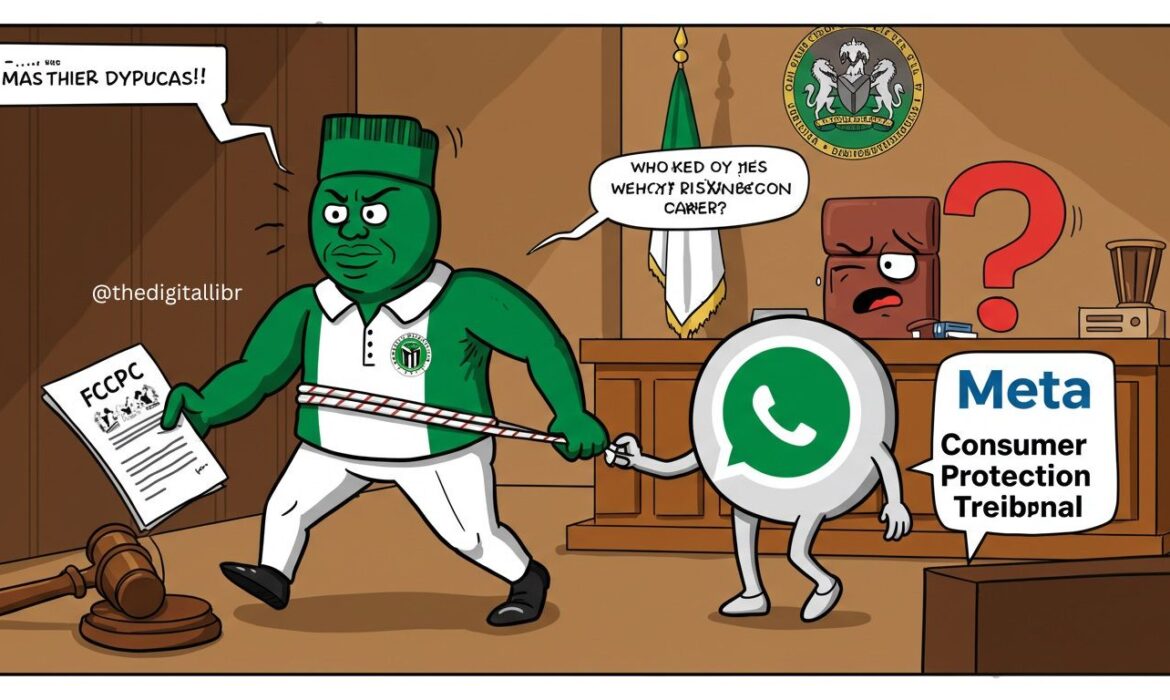
FCCPC Dragged Meta to Court and Won, but what’s Next?
Recently, the Federal Competition and Consumer Protection Commission (FCCPC) made headlines for winning a case against Meta (the parent company of WhatsApp, Facebook, and Instagram). The Competition and Consumer Protection Tribunal (CCPT) upheld a $220 million fine that was earlier imposed on Meta, including an additional $35,000 that was awarded to the FCCPC for the cost of the investigation, which started in year 2020. More details on FCCPC Website.
These issues started because WhatsApp ‘allegedly’ refused to cooperate with FCCPC and they have responded to the decision of the CCPT.
- But by this update, is it possible that Meta will stop doing business with Nigeria or they will just go ahead and pay these fines?
- Is there a future where WhatsApp might stop working in Nigeria if this battle continues?
While the effort of FCCPC is commendable, these ‘tech big players’ sometimes comply and other times push back hard. But at the end of the day, it is consumers like you and I that gets caught in the middle.
That’s why this article is more of a wake-up call. Let us be more cautious with how we use online platforms. Yes, we need to communicate, yes, we need these services and tools, but let’s not forget that we’re not entirely in control, and even though they make us read long Terms/Agreements before using their apps, we still have no complete idea of what ‘they’ do with our data.
So, What do you think, should Nigeria push harder or back off? And with everything happening in the digital world right now, there is AI, etc. one can’t help but wonder: are we gradually losing control over our digital lives?
Sylvester I. Ebhonu, CLN, amPAIDeF
Youtube Channel @ https://youtube.com/@thedigitallibr
#DataPrivacy #AIGovernance #InternetGovernance #Policy

This Shouldn’t be Happening at the National Library of South Africa
I just read about the unfolding situation at the National Library of South Africa (NLSA), and I’m very concerned about it. The leadership position of the NLSA (National Librarian/CEO) was recently re-advertised. But this time, the title “National Librarian” was quietly dropped, and Library and Information Science (LIS) qualifications have been downgraded from a requirement to just a “preference” according to a petition championed by Lesetsa Sanele
But, how can a National Library be headed by someone who is not even a librarian? Is this not a huge blow to the integrity of the LIS profession? Honestly, the role of who heads a National Library is too strategic to be treated like any another administrative job. Imagine appointing a Doctor as a President of an association of Lawyers? Through conversations on the Librarian Spotlight Africa (LSA) platform, we’ve seen this kind of thing happen in other countries too, including here in Nigeria. And every time, actions like these just weakens the system. Our Libraries deserve better!
This isn’t just a South African issue, it affects all of us who care about the future of libraries, access to information, and preservation of Africa’s heritage. In the interest of transparency and accountability, the petitioners are urging the NLSA Board to take immediate action to address these concerns.
1. Immediate public release of the names, qualifications, and professional backgrounds of all current NLSA Board members.
2. A firm commitment that the future leadership of the NLSA, specifically the National Librarian/CEO, will be selected based on professional LIS standards.
3. A complete stop to the appointment of the National Librarian who is not a librarian
Interestingly, this is not the first time an action is taking to discourage such moves. On 17th of March 2025, the Library and Information Association of South Africa (LIASA) raised the alarm in a post on their official Facebook page, reminding everyone that “we’re seeing a repeat of what happened in 2019”when the NLSA Board also attempted to appoint a non-librarian to lead the National Library.
If we’re going to build strong knowledge institutions in Africa, then we need the right people in the right positions.
So I’m lending my voice by signing this petition, and I’m encouraging you to do the same. As of today, 12th April, 2025, over 800 people have already signed, and we need to push it to 1,000 and even beyond. Librarians leading libraries. Period. Sign the Petition here:
Sylvester I. Ebhonu, CLN, amPAIDeF
Youtube Channel @ https://youtube.com/@thedigitallibr
#StandWithNLSA #LibraryLeadership #AfricanLibraries #LSA
WHY PROFESSIONAL EMAIL IS INTEGRAL TO INSTITUTIONAL IDENTITY?
An average email user today will tell you they prefer a Gmail to a Yahoo mail, and the reason is not far fetched. 80% of Entrepreneurs prefer Gmail to Yahoo mail. Signing up for a Gmail Account gives you access to a wide variety of Google products and services that can be of help, regardless of the kind of business you do. But as an institution or a company, have you considered the implication of not having a professional email address? Do you know there are implications for letting your staff use their personal email for official communications? A personal Gmail or Yahoomail address is different from a professional email address.
Every business that takes branding or its professional identity serious ensures that official email service forms an integral part of their institution or organization’s identity. Whether it’s an academic institution or corporate organization or SMEs, the importance of maintaining a professional and branded email system cannot be overemphasized. Many organisations, and a few institutions today, seem to overlook this important aspect of their digital identity, falling back to personal email accounts for professional correspondence. This oversight can lead to security risks, missed opportunities and reduce the credibility of such organizations and institutions. This ‘looong’ blog post therefore seeks to explore some of the benefits of professional email services and how they contribute to the identity and functionality of an organization, whether its educational or business.
WHAT IS A PROFESSIONAL EMAIL?
According to Zoho Mail, “A Professional email address is the email address you use primarily for your work related communication.” Ther email address usually include the name of the company or institution you work for. So for example, instead of using a free service like Gmail or Yahoo (e.g., amaka.okon@gmail.com), an organization or institution might issue their employees or students with an email address that ends with the institution’s domain name, for instance amaka.okon@adun.edu.ng, in some other cases we see something like library@adun.edu.ng (that’s if it is intended to serve a department like a Library or Registry, etc).
So, why is this worth learning about? Ideally, professional email (custom domain), which in this article can be used to represent institutional/organizational/official or business email helps to give an impression of trustworthiness in your communications. It plays a major role on how your institution is perceived. No doubt, Gmail and Yahoo provide free services, but they don’t give the impression of professionalism especially in the academic system. I could use my personal Gmail address for my personal communication with family and friends, but when communicating on behalf of my institution or organization with a Vendor, or a Researcher in a collaborative project, or an editor of a journal, it raises some questions about reliability and security. While an Institution cannot have administrative control over personal emails of employees or students, professional email services come with these features, hence they are recommended and used widely for institutional/organizational communications.
WHY SHOULD ORGANISATIONS/INSTITUTIONS CARE ABOUT PROFESSIONAL EMAIL?
In an ideal situation, your institution or organisation’s email would be the first point of contact with stakeholders and all those you wish to have any transaction or collaboration with. It could be a Prof. emailing his project student, or a researcher submitting an article to an international journal, or perhaps applying for a grant. Truth is, you don’t want to give a wrong first impression that you are not a legitimate member of staff or student of that institution, especially when dealing with external bodies. This is why institutions and organizations need to ensure they not only provide professional email for their communities, but also ensure the system is sustainable. Here are some specific reasons why you should care about Professional Email as an Entrepreneur, Academic or Administrator:
- For Security: Many organisations today face the risk of email security. With increase in phishing attacks and data breaches, using secured platforms like Google Workspace or Zoho for example, can help institutions safeguard communication and protect emails with encryption and other safeguarding features that can prevent unauthorized access.
- For Branding and Email Customization: Email service providers usually allow subscribers to customize their email signatures, programme auto-responders and a variety of other custom features which can help in enforcing an organisation’s brand identity.
- Professionalism and Trust: Think about this for a moment. If you receive an email from renoomoraka@yahoo.com, and another email from reno.omoraka@hisinstitutionname.com, don’t you think they both will convey different impression about professionalism? Receiving an email with your institution’s domain name gives people no reason to doubt, the recipient immediately builds trust.
- Collaboration and Efficiency: Many of these professional/Institutional email service providers offer a suite of productivity tools that help institutions or business streamline their communication and collaboration. Some of those features, depending on the platform (e.g. Google, Zoho, etc) features calendars, task management tools, Virtual meetings, project management tools, file sharing features, etc. All these features are needed especially in an academic setting where faculty, students, and staff must collaborate on various projects, from research to curriculum development. Gone are the days where students will have to print volumes of their project works repeatedly for correction, when all that can be achieved via email or a collaborative platform like Google.
flexible pooled storage per user that is shared across the organization.
- Administrative Control: With a company email address, you have control over the accounts. If an employee leaves, you can ensure business continuity by redirecting their emails or reassigning the email address.
The following are other benefits of a Professional Email Service as recommended by Zoho, (an Indian multinational technology company that makes computer software and web-based business tools, popularly known for their mail service, as well as Office Suite):
- Branding
- Builds trust
- Authenticity
- Reliability
- Ease of recalling
- Better deliverability and reputation
I hope you’re not getting bored reading this already?
Having looked at the benefits, it’s also important to understand what’s at stake when institutions neglect to adopt a professional email system.
WHAT IS AN INSTITUTION/ORGANISATION RISKING WITHOUT OFFICIAL EMAIL SERVICE?
The risks of not using a professional email service will not be over-emphasized in this article. So, let’s just explore these three:
- Risk of being Vulnerable to Security: In most sectors in the economy today, Email remains the main medium for communication, and this makes it a main target for cyber attacks. Who knows, could this be why some institutions in Nigeria prefer the use of memo, notices board and wasting a lot of print resources rather than leveraging digital? That’s a story for another day. The point, however, personal email accounts as earlier explained are more exposed to threats than professional email systems. Let’s describe what this means: The email of a prominent member of an institution for example has a high chance of data breach and hacking if that Staff operates a private email on behalf of the institution. This is not to say that having a Professional Email Service in an organization shields you permanetly from cyber threats. A statistics report by Fortra shows that one of the most potentially damaging hacks, Business Email Compromise (BEC) continues to cause billions of damage every year. See Report below:
- Risk of inefficiency in Communication: Institutions today, who allow their staff to engage in official communication, research and transactions without a centralized email service risk losing out on important details. Think about the email threads that will get lost if a staff stops working for you or important emails that a staff may receive and not pay attention to. A centralized email system allows the organization to have an efficient storage for communication.
- Risk of losing Credibility: Without a professional email system, an institution could be compromising their reputation. Emails from free platforms, like Gmail or Yahoo, can give the impression that the organization is unprofessional or not serious. In the academic setting for example, this is not even negotiated, many institutions will not accept your application for grant, for support or publication without your communication coming with an official identity.
Click to Learn more about “why employees should never use personal email accounts when conducting business.”
MAXIMIZING THE VALUE OF YOUR INSTITUTIONAL EMAIL: BEST PRACTICES
For users (employees, academicians, students, etc) to fully capitalize on the advantages of a professional email system, institutions and organizations should adhere to the following best practices:
- Develop clear email policies that should outline the expectation of professional communication by your users. For instance, using ‘Institutional Emails only for work-related communications and for professional relationships.’
- Enjoy your investment! Maximize the full potential of your email service provider. Many institutions only use the email service, and abandon other integrated productivity and project management tools like we mentioned above earlier. Most times, your payment covers for all these, but you don’t maximize them. For instance subscribing to Google workspace plans allows you to use google meet and record your meetings.
- The CISA recommends that we use strong passwords to keep threat actors from stealing our information. Regularly updating your passwords, enabling two-step verification and educating staff and students on email security are also important steps in maintaining a secure email system.
CONCLUSION
This is not an article intended to market any Email Service Provider, but one that hopes to enlighten business owners, administrators, academics, key stakeholders of organizations and institutions that a Professional Email is not just a means of communication, but that it forms an integral part of an institution or organizations identity.
Bear in mind the cost implication for adopting a professional email system is not ‘small money’. You may wish to consult ICT experts to recommend the best service if you’re considering setting up one for your establishment. That singular move can boost your organisation’s credibility, ensure security, and promotes efficiency. Institutions that prioritize an efficient email system are positioning themselves for success.
If your organization or institution has assigned you an official/institutional email, please share with us your experience using it in the comments.

I tested it! With a Good Prompt ChatGPT can now Turn your Photo into 3D or Cartoon
How to Use Prompts to Turn Your Photo into a 3D, Cartoon, or Anime Image with ChatGPT
By Sylvester Ebhonu (TheDL)
Prompting is all about being descriptive, expressive, and creative. Unlike the days of Google Search Engines, where we cared so much about Keywords and Boolean search, getting results using Reasoning Engines like ChatGPT, BingAI, Midjourney, etc requires you to be able to expressively describe what you want. Being descriptive doesn’t mean you have to write so much grammar. Most times, you just need a well-crafted sentence. Even if you use your local language, as long as the model understands it, it will respond based on your instructions. Just as I’ll share with you shortly, you’ll see that just a sentence is enough to do the magic.
If you’re creating 3D-style images, it’s important to know the specific visual style you want your image to reflect. The styles recommended below are currently trending online, especially since the “Create Image” function was added to the latest ChatGPT updates. According to Reuters, Ghibli effect: ChatGPT usage hits record after rollout of viral feature
What You Can Now Do with ChatGPT’s Create Image Feature:
Users can now:
- Turn their uploaded photo into a cartoon, 3D style, anime, or a sketch.
- All you need to do is upload an image and prompt ChatGPT to transform it based on your preferred style (let’s say Pixar, Disney, Tom and Jerry, etc.).
As OpenAI described in one of their product releases on 25th of March, 2025: “Creating and customizing images is as simple as chatting using GPT-4o — just describe what you need, including any specifics like aspect ratio, exact colors using hex codes, or a transparent background. Because this model creates more detailed pictures, images take longer to render, often up to one minute.”
How to Transform Your Photo into a 3D or Cartoon-Style Image
Step 1: Upload your photo (In this case I Uploaded the photo on the right below).
Step 2: Use a descriptive prompt like mine:
The Prompt: “Create a 3D animated portrait in a stylized, cinematic animation style reminiscent of Pixar with a touch of DreamWorks charm. The subject should closely resemble my reference photo, wearing sleek glasses and smiling.”
Step 3: Give it a minute or 2 and your result is on the way (See my result on the left below, with a little adjustment on the contrast)

Five Prompt Styles you should Try out
Using these prompt ideas can help you generate creative images for profile pictures, storytelling, or content creation across different fields. The styles are universally relatable:
Studio Ghibli Style: This prompt style is inspired by the iconic Japanese animation studio behind movies like Spirited Away, Howl’s Moving Castle and the likes. You can try prompts like:
-
- Create an anime portrait in the style of Studio Ghibli, with warm lighting and expressive eyes.
- Turn this photo into a Studio Ghibli-style character with a magical forest background.
Pixar Animation Character Style: It’s known for its 3D animated look, big shiny eyes, and smooth textures. Try a prompt like:
-
- Turn this image into a Pixar-style animated character with a joyful expression and a colorful background.
LEGO Minifigure Version: They are blocky in nature, also have toy-like appearance and colourful too. Try this prompt:
-
- Reimagine this person as a LEGO minifigure standing in a LEGO city.
Simpsons-Style Character: This prompt transforms your image into a 2D cartoon style from the popular ‘The Simpsons TV series’. The Characters are usually with Yellow skin, bulging eyes, with over exaggerated expressions, looking really very funny in appearance. Prompt Example:
-
- Transform this image into a character from The Simpsons, with the classic yellow skin and cartoon vibe.
Disney Character Concept: This prompt style is inspired by popular princess/prince/fantasy characters we watch in movies like Frozen, Aladdin, etc. They are sort of fairytale-inspired portraits. Try a Prompt like:
-
- Turn this photo into a Disney princess-style character in a magical forest setting.
- Make me look like a Disney/Pixar character.
Some other Prompts to explore with
- Create a superhero cartoon version of this person, with a cape and glowing eyes.
- Turn this face into a comic book hero illustration.
- Turn this photo into a Renaissance-style oil painting.
What do you think about this latest update in ChatGPT?
Right now, OpenAI’s ChatGPT offers some very impressive features, from text, voice, and image generation to this new “Create Image” function, you enjoy them more on ChatGPT Plus, but the free option is honestly doing so much already.
But the big question is ‘How long will this last? Will OpenAI keep being generous as they have been since year 2022, or will they eventually switch to the model we’ve seen with other platforms, where you only get limited freemium access before the real features you are interested in gets locked behind a paywall?
Only time will tell. But while it lasts, don’t you think we should make the most of these tools ethically and create content that makes sense?
Don’t forget to share if this post helped you in any way!
Watch a Step by Step Video on How to Create your Cartoon or 3D Image on my Channel:
Your coach and friend,
Sylvester I. Ebhonu, CLN, amPAIDeF
Youtube Channel @ https://youtube.com/@thedigitallibr