WeeK 5 of 7 Habits for Year 2024 – (THINK WIN-WIN) Stephen Covey’s Book Review
Last weekend, which marks the fifth week of our enlightening 8-week journey through Stephen Covey’s book, “The 7 Habits of Highly Effective People,” our focus was on the fourth habit: Think Win-Win. The session was very rich as Mr. Oghenero Ohwobete, a purpose-driven leader and media enthusiast, offered practical insights into the essence of mutual benefits in our interactions and negotiations.
We started with part three of the book, transitioning from independence to the paradigm of Interdependence. Covey’s assertion that “effective interdependence can only be built on a foundation of true independence” resonated deeply, underscoring the importance of personal mastery before engaging in fruitful collaborations. This principle as he describes, is like mastering algebra before venturing into calculus, and it drives home the point that personal development, management, and private victory, which is the part two of the book lays the groundwork for successful interpersonal relationships.
According to Covey, Think Win-Win is not merely a strategy but a comprehensive philosophy for life and work. It transcends the narrow confines of personal gain to embrace a broader perspective where success is shared and multiplied. Our Guest Reviewer, Mr. Ghenero outlined the core of this habit and emphasized on character and integrity. These foundational traits ensure that our pursuits of mutual benefit are grounded in sincerity, trustworthiness, and a genuine concern for the welfare of others. “The Principle of Win-Win is fundamental to success in all our interactions, and it embraces five interdependent dimensions of life: Character, Relationships, Agreements, Supportive Systems(Structure) and Processes.

“The Six Paradigmns of Interaction:
1. Win-Win
2. Win-lose
3. Lose-win
4. lose-lose
5. Win
6. Win-Win or No Deal TM
“Of these philosophies so far — win-win, win-lose, lose-win, lose-lose, and win -which is the most effective? The answer is, “It depends.” If you win a football game, that means the other team loses. The best choice, then, depends on reality. The challenge is to read that reality accurately and not to translate win-lose or other scripting into every situation.”
Mr. Ghenero also shared practical strategies and personal stories that brought the concept of Think Win-Win to life. From the collaborative success of the ‘BreakitDown Initiaitive Platform’s’ activities to harmonious resolution of potential conflicts in professional settings, these examples illustrated the tangible benefits of adopting a win-win approach. By prioritizing shared goals, empathetic understanding, and transparent communication, we can forge relationships that are not only productive but also enduring and fulfilling.
As we reflect on last week’s session, we are encouraged to integrate the Think Win-Win habit into our daily lives. Whether in professional collaborations, family relationships, or community engagements, approaching interactions with a win-win mindset can transform potential conflicts into opportunities for shared success. By committing to a balance of courage and consideration, as recommended by Covey, we can navigate our interactions with a focus on mutual benefit and collective well-being.

WATCH THE REPLAY HERE:
Next is Habit 5 – Seek first to understand, then to be understood, we are reminded of the importance of empathetic listening and meaningful communication in building strong, effective relationships. The principles of interdependence, as explored through Think Win-Win, set the stage for deeper understanding and collaboration, paving the way for a more connected, compassionate world.
To achieve your Career and Personal Development Goals, join the Upskill and Connect Village –
LIBRARIAN SPOTLIGHT: PROF. YETUNDE ZAID RECOGNIZED AS LIBRARIAN OF THE MONTH FOR FEBRUARY
The maiden edition of the Librarian Spotlight series, which was held on 16th February 2024, featured an engaging interview with Professor Yetunde Zaid, the University Librarian of University of Lagos (UNILAG), Nigeria. The choice of Professor Yetunde Zaid as the spotlighted librarian was particularly noteworthy. Her story is one of remarkable ascent within the academic library sector, culminating in rising from a fresh graduate serving at one of Nigeria’s most prestigious institutions to becoming a Librarian Professor.
This innovative series, hosted by Sylvester Ebhonu (The Digital Librarian) and Victoria Edozie (The Shekere Queen), not only celebrates contributions of exceptional professionals, but provides insights into the evolving role of libraries in the digital era. The focal points of this enlightening and engaging first edition were Prof. Zaid’s career and achievements.
THE INTERVIEW
One of the key lessons drawn from our interaction with Professor Yetunde was the critical role of technology in modern librarianship. Professor Yetunde’s initiatives, particularly her work in integrating assistive technologies for the visually impaired and the innovative use of the humanoid robot named “Robo Scholar” in UNILAG Library, underscore the importance of leveraging technology to enhance library services and accessibility. This approach not only makes library resources more accessible to a broader audience but also demonstrates how libraries can lead in the adoption of innovative technologies to improve user experience.

Throughout the interview, Professor Yetunde emphasized the importance of vision, advocacy and leadership in the library profession. When asked what the biggest challenge facing librarianship is in Nigeria, she noted the ‘rapid evolution of technology, hence the need for library associations to “see how they can help to build technological skills of librarians” by organizing regular workshops, thinking beyond just conferences and also placing emphasis on professional networking.
LIBRARIAN OF THE MONTH
In recognition of her outstanding contributions to the library profession and her pioneering work in library and information science, Professor Yetunde was honored with a Plaque and a printable Certificate as the Librarian of the Month for February.

Prof’s story is indeed proof that a career in librarianship can be filled with opportunities for advancement and that there is great potential within the library profession, provided one is willing to embrace change, seek out learning opportunities, and take on challenges. So, from embracing technology and advocating for the profession to focusing on inclusivity and the importance of continuous learning and professional development, the session highlighted many facets of librarianship.
WATCH THE REPLAY HERE:
As the Librarian Spotlight programme continues, it promises to be a vital platform for knowledge sharing, inspiring innovation, and celebrating the achievements of librarians who are making a difference in their communities and the world at large. Next month promises to be another enlightening experience.
‘Librarian Spotlight – amplifying impact to inspire positive change’
WEEK 4 of 7 Habits for Year 2024 – (PUT FIRST THINGS FIRST) Stephen Covey’s Book Review
In our fourth week journey through Stephen Covey’s transformative “7 Habits of Highly Effective People,” we arrived at a pivotal point last weekend: Habit 3 – Put First Things First. The session, enriched by the insights of our guest, Pat Uche Nwachukwu (a publisher, writer, and a fervent advocate for productivity and personal development), covered the critical distinction between urgent and important tasks, the role of personal management, the power of saying no to non-essential tasks to focus on what truly matters and the art of effective delegation.
This habit emphasizes Covey’s Time Management Matrix – a concept that categorizes tasks into four quadrants based on urgency and importance. There is need for us to prioritize and execute tasks based on their importance rather than their urgency, enabling us to manage our time and energy more effectively. Sylvester emphasized how focusing on Quadrant II (Not Urgent but Important) tasks can lead to breakthroughs in our productivity and well-being. This quadrant, often neglected, holds the key to proactive life management.

“Put First Things First” is about life management. It’s the physical embodiment of our priorities and values, manifesting in the daily choices we make. According to Pat “It’s not about clocking hours; it’s about creating value,” highlighting the shift from being busy to being effective.
Learning to Say “No”
A recurring theme during the review was the empowerment found in saying “no” to non-essential tasks. This isn’t about being dismissive, but about honoring our values and priorities. Pat shared strategies for declining requests gracefully, ensuring that relationships are maintained while boundaries are respected.
The ability to delegate effectively was also a critical skill discussed that everyone needs in putting first things first. It’s not merely offloading tasks; it’s about entrusting responsibilities to others, fostering growth and development. We discussed how effective delegation involves clear communication, trust, and the release of control, allowing others to bring their strengths to the table.
The Emotional Bank Account
Touching on the concept of the Emotional Bank Account, we explored the importance of building trust in relationships through consistent, positive interactions. “Every commitment kept, every promise fulfilled is a deposit,” Pat shared, underscoring the relational aspect of effectiveness.
Conclusion
As we wrapped up the enlightening session, it was clear that “Put First Things First” is more than a habit; it’s actually a way of life. It challenges us to look beyond the immediacy of our tasks and to consider the legacy we wish to leave behind. The session wasn’t just theoretical; the reviewers provided actionable steps as recommended in the book to integrate Habit 3 into our lives. From weekly planning sessions focused on Quadrant II activities to daily reflections on our personal mission statements, these practices offer a roadmap to a more organized and value-driven existence.

In embracing this habit, we are called to be architects of our destinies, crafting days that resonate with our core values and aspirations. It’s a journey of constant learning, unlearning, and relearning, as we strive to align and apply Covey’s suggestions.
Watch the Replay here:
Next is Week 5 – where we delve into Part 3 and Habit Four – “THINK WIN-WIN. Join us!
To achieve your Career and Personal Development Goals, join the Upskill and Connect Village –
WEEK 3 of 7 Habits for Year 2024 – (BEGIN WITH THE END IN MIND) Stephen Covey’s Book Review
In our third week of the enlightening 8-week series exploring Stephen Covey’s “The 7 Habits of Highly Effective People,” we delved deep into the second habit: ‘Begin with the End in Mind’. This session was graced by the insightful contributions of Edesiri, a psychologist and community development advocate, who brought a unique perspective on envisioning our ultimate goals and recognizing what lies at the center of our lives.
Leadership vs. Management
A pivotal distinction highlighted in this week’s discussion was between leadership and management. Leadership involves setting the right direction and ensuring we’re headed toward the right ‘jungle,’ while management focuses on efficiency within the chosen path. This analogy served as a powerful reminder of the importance of aligning our daily actions with our broader life goals.
Another Visualization Exercise
An exercise from Covey’s book, urges us to visualize attending our own funeral. This potent imagery forces us to reflect on how we wish to be remembered, which in turn, clarifies our values and aspirations. Such visualization exercises not only help in defining our personal mission but also in rescripting our lives towards those ends. So the big question is, “When you die, what would you like your family, friends and colleagues to say about you?”
According to the author, the most effective way to begin with the end in mind is to develop a personal mission statement. This concept was discussed as a tool for encapsulating our values and goals. These statements act as a guiding constitution, providing clarity and direction in our decision-making processes. Emphasis was laid on the importance of these statements being personal, positive, present tense, visual, and emotional, to truly resonate and drive our actions.
Centers of Our Lives

A significant part of the discussion revolved around what lies at the center of our lives and how. ‘Security, Guidance, Wisdom and Power are the four life-support that create the force of a noble personality. Various centers, such as family, work, money, and self, can drive our decisions and behaviors. However, Covey advocates for a principle-centered approach, where our actions are guided by timeless and universal principles. This approach ensures a balanced development of security, guidance, wisdom, and power, leading to a more effective and fulfilling life.
Application Suggestions
As we concluded the session, practical suggestions were provided to incorporate the discussed habit into our lives. Participants were encouraged to take time to reflect and write down their personal mission statements, considering what truly matters to them. The exercise of visualizing one’s funeral was recommended as a starting point for this reflective process.

In summary, Habit 2 encourages us to reflect deeply on our personal values and life’s purpose, ensuring that our day-to-day actions are in harmony with our aspirations. It’s about living a purpose-driven life, not the default life, and taking responsibility for shaping your own destiny.
Watch the Replay here:
We look forward to next week’s discussion on Habit 3, where we will explore putting first things first, further building on the foundation laid by the first two habits. Join us next weekend and be part of this transformative journey.
To achieve your Career and Personal Development Goals, join the Upskill and Connect Village –
WEEK 2 of 7 Habits for Year 2024 – (BE PROACTIVE) Stephen Covey’s Book Review
In the second week of our 8-week journey through Stephen Covey’s “The 7 Habits of Highly Effective People,” we discussed the first habit: Be Proactive. We were honoured to have an enlightening dialogue with our guest – Maryann Mbat, who shed light on the profound impact of proactivity on personal and professional growth.
Self-Awareness and Breaking Free from the Social-Mirror
Proactivity is more than just taking the initiative. It’s about recognizing our responsibility to shape our lives, decisions, and responses, independent of our external conditions. Covey emphasizes the unique human ability to reflect on one’s thoughts and actions, a trait that sets us apart from the animal kingdom. This self-awareness enables us to choose our responses to the stimuli around us, thereby defining our reality.
We were able to explore how the “social mirror” often distorts our self-perception, reflecting not who we truly are but how others see us. Covey eloquently describes this phenomenon: “Our view of ourselves is like the reflection in the crazy mirror room at the carnival.” He suggests that these reflections are more about the projections of others’ insecurities and less about our true selves. This can be a mix of their perceptions, paradigms, and even their insecurities. Covey challenges us to look beyond these reflections and to understand that we are not solely products of our environment or genetics but of our choices and responses.
Proactivity vs. Reactivity
Proactivity is defined by Covey as the responsibility we hold for our lives, where our behavior is a function of decisions, not conditions. “Proactive people recognize their ‘response-ability’—the ability to choose your response,” Covey explains. This contrasts starkly with reactive people, who often absolve themselves of responsibility, attributing their behavior to external factors.
Maryann, during the webinar, highlighted this distinction with real-life examples, illustrating how proactive individuals choose their actions based on values and not on their environment or conditions. They focus their energy in their Circle of Influence, working on what they can impact, which in turn, magnifies their influence.

The language we use serves as a mirror to our mindset. Reactive language often relinquishes responsibility, with phrases like “That’s just the way I am” or “There’s nothing I can do about it.” In contrast, proactive language embodies empowerment and accountability, focusing on what can be controlled and influenced.
A key concept discussed was the Circle of Concern and Influence. Whether facing direct, indirect, or uncontrollable problems, proactive individuals recognize that the first step to a solution lies within the circle of influence – things you can control, not things you cannot control – circle of concern.
The Challenge and Application Suggestions
To bring these concepts to life, we proposed a 30-day challenge recommended in the book and encouraging participants to be committed to it as they act within their Circle of Influence, embracing proactive responses over reactive ones. This includes being a light, not a judge; setting positive examples; and learning from mistakes.

The review of the first Habit – Be Proactive lasted for 45 minutes and the message was clear: embracing proactivity is embracing the power of choice. It’s about recognizing that our responses, not our circumstances, define our reality. This realization is pivotal to personal growth and effectiveness.
Watch the Replay here:
Don’t miss the next review (Habit 2).
To achieve your Career and Personal Development Goals, join the Upskill and Connect Village – visit https://www.thedigital-librarian.com/upcoming-events
WEEK 1 of 7 Habits for Year 2024 – (An Overview) Stephen Covey’s Book Review
Last weekend marked the exciting start of an 8-week journey reviewing the powerful lessons in Stephen Covey’s Book – “The 7 Habits of Highly Effective People”. Published in 1989, this influential book has sold over 25 million copies worldwide and shaped many people’s thinking on effectiveness and success.
Kicking off the first day of the review, the host Sylvester, started by highlighting some of the extensive praise that the book has received from experts in various fields. For example, we read out the endorsement stating that the book can help you “live permanently in the winners circle” – emphasizing the profound impact the habits can have.

After setting the stage, we summarized the structure and core concepts of the book, which provides a strategic sequence – first mastering self-discipline and then using that foundation to improve relationships and interactions. Renewal ensures you continue growing. Or as Covey put it, private victories precede public ones. The four major parts of the book:
- Part 1 covers paradigms and principles
- Part 2 deals with “private victories”
- Part 3 focuses on “public victories”
- Part 4 is about renewal
An important distinction made early in the book is between personality ethic and character ethic. As we learned, personality ethic is the idea that success just comes from image, techniques and behaviors that can be quickly learned. But character ethic focuses on integrity, humility and other virtues that take time to cultivate.
The book emphasizes character ethic as the superior path, whereas much of society embraces personality ethic. As Sylvester noted, we cannot simply learn to have integrity – it must be built over time. This ethic aligns with the “inside-out” approach recommended in the book.
The Power of Paradigms
According to how the author compared paradigms to maps – if your map does not accurately reflect the territory, you will keep getting lost no matter how hard you try. Likewise, we can be ineffective if our mental maps and assumptions about life are flawed.
To illustrate this, we carried out an engaging exercise in the book, with a classic sketch that can be seen as either a young or old woman. By first asking people what they saw and then prompting them to try seeing it from another perspective, he demonstrated how strongly our perceptions can be shaped by conditioning.

This ties into the notion of paradigm shifts – those sudden “aha” moments when we finally start looking at something in a new way. The book emphasizes being open to paradigm shifts rather than being stuck in old thinking.
Principles vs Paradigms
Connected to this is the distinction between principles and paradigms. Principles are like lighthouses – timeless natural laws that provide guidance. Paradigms are our individual perspectives that can always be expanded, evolved or shifted. We took a few moment to read a story from the book about the Captain of a ship who kept insisting the lighthouse move out of his way, not understanding it was rooted in unchangeable principles.
This story highlights that we cannot force or fight the principles of life, only align our paradigms with them through better understanding.
Inside-Out Approach
Because flawed perceptions are often the root issue behind ineffective behavior, the book advocates an “inside-out” approach to change. This means focusing first on self-mastery and private victories before trying to change outward behaviors, and of course, this has to be tied into the structure of the 7 habits.
Overview of the 7 Habits
Mr. Grandee Ughoton a Guest Reviewer summarized what each of the 7 habits represents:
- Be Proactive – Take responsibility for your life rather than blame external factors.
- Begin with the End in Mind – Define your values, goals and direction to ensure you live intentionally.
- Put First Things First – Prioritize and focus on the vital few actions that matter most.
- Think Win-Win – Adopt a mindset of mutual benefit rather than zero-sum competition.
- Seek first to understand, then to be understood – Communication is more effective when you listen deeply rather than react.
- Synergize – Tap into collaborative creativity to find combined solutions.
- Sharpen the Saw – Commit to continuous self-renewal mentally, physically, spiritually and emotionally.
The author emphasized that habits 1-3 make up the “Private Victories” dealing with self-mastery, while 4-6 are the “Public Victories” dealing with relationships. Renewal ensures you have continuous growth.
Application Suggestions
Throughout the first day’s review, we focused not just on explanation but on application. Stephen Covey guarantees results for those who apply the material consistently over time.
To start the application process, the host – Mr. Sylvester Ebhonu (The Digital Librarian) suggested two initial exercises:
- Identify your own paradigms in life by considering how you view your work, relationships, challenges, communication style and so on. See if you can shift perspectives.
- Make a habit over the next week of trying to understand situations from multiple points of view before reacting. Think win-win.
- He also strongly encouraged everyone to obtain their own copy of the book to fully engage with the material during this 8-week journey.
In summary, the first day reviewing The 7 Habits provided an inspirational introduction to the key ideas and frameworks that will be explored in more depth over the coming weeks. The concepts of paradigms, principles, private victories and habits have already sparked great discussion and reflection.
Watch the Replay here:
This program promises to be a transformative opportunity for all those who engage fully with the principles taught. We will keep you posted on each week’s outcome and how to put these Habits into practice!
To achieve your Career and Personal Development Goals,
join the Upskill and Connect Village –
7 Habits that will transform your life in Y2024
Books by Stephen Covey have touched millions of lives, and among them, ‘The 7 Habits of Highly Effective People’ stands out. It steers away from the prevalent personality-centric narrative and, instead, champions the character ethic.
Sylvester Ebhonu (The Digital Librarian) is set to kick off the 8-Week Review of the book, providing insights and an overview of the transformative habits that viewers and participants can adopt to thrive in the year 2024 and beyond:
Habit 1 – Be proactive
Habit 2 – Begin with the end in mind
Habit 3 – Put first things first
Habit 4 – Think win win
Habit 5 – Seek first to understand then to be understood
Habit 6 – Synergy
Habit 7 – Sharpen the saw
To achieve your Career and Personal Development Goals, join the Upskill and Connect Village – visit https://www.thedigital-librarian.com/upcoming-events.
Summaries will be posted on my blog: https://www.thedigital-librarian.com/blog/
ARTIFICIAL INTELLIGENCE WILL NOT BE A REPLACEMENT FOR HUMANITY – PROF OMAJI, VC ADUN
BREAKING NEWS:
Vice Chancellor of Admiralty University of Nigeria (ADUN) Prof. Paul Omojo Omaji, says Artificial Intelligence, despite its impact in almost all sectors of life, will not be a replacement for humanity, but will be a great tool that will propel economic, educational, and transformational development, and serve as a tool for productivity and uplifting humanity to a higher plain of greatness.
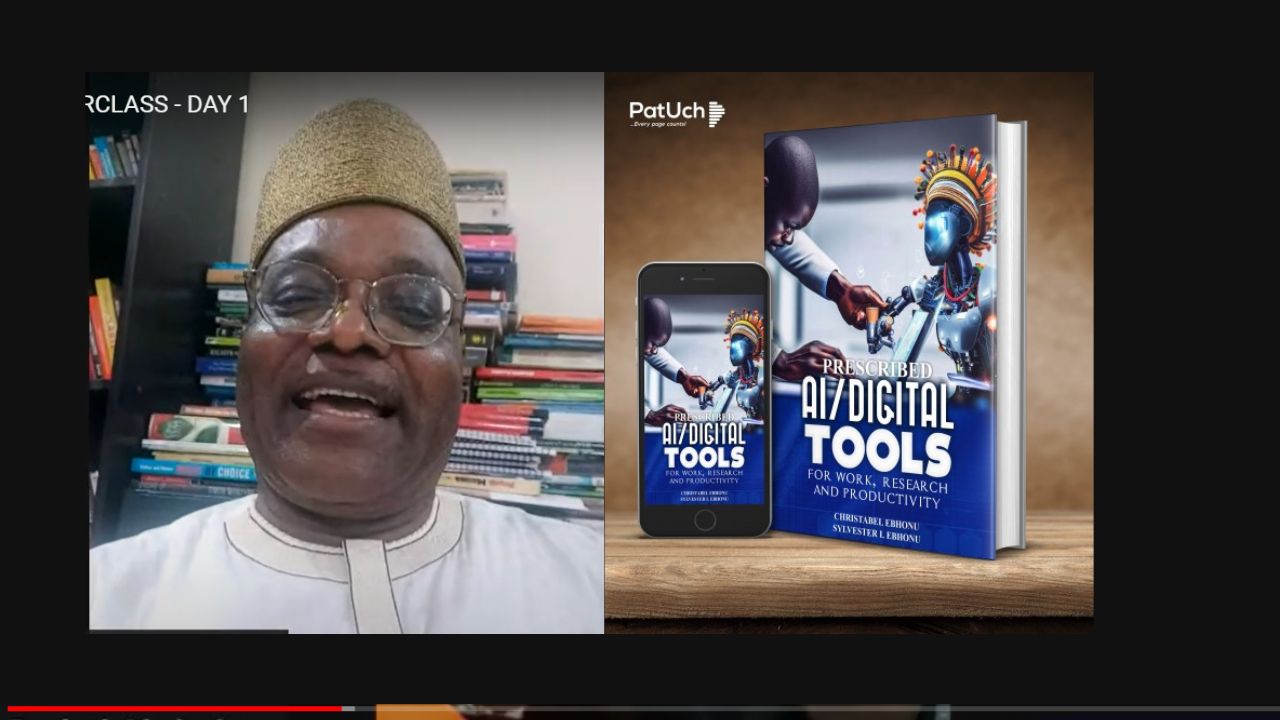
The Professor of Criminology who stated this at the Opening Ceremony of the Virtual Artificial Intelligence Masterclass (AIM) in Work and Research Productivity on Saturday 24th June, 2023 also launched an e-book authored by staff of the University – Christabel and Sylvester Ebhonu (Conveners of the Virtual Programme) describing the Masterclass as a ‘Master Stroke’. Responding to some misgivings expressed about Artificial Intelligence not just replacing humans or taking their jobs, but displacing God in the future, Omaji says, “Artificial Intelligence will continue to be a tool, but it will not be a replacement of humanity.”
In his review of the e-book titled: Prescribed AI/Digital Tools for Work, Research and Productivity” , Prof. Omaji said this about the authors:
“Sylvester and Christabel have joined their efforts, their interest, curiosity, and their purpose-driven lives, to put together this book being launched today. In the book, you would find incredible tools that will enable you to navigate in your research, work environment, and in your passion for productivity; the tools that will help you to acheive greatness with minimal effort. In other words, they have put together a book that already points you to areas where you can identify the tools that will help you. It is only a lazy person that blames the tools that you use, because the tools are there… and what these young people have done is actually to fish them out, having shown their own passion in this area and having indeed, used some of these tools to great benefit, they are introducing the tools to the whole world and inviting all of us to develop active interest and engagement with the tools so that we can increase in our own productivity.
I cannot overrate this particular work, yes, it is a kind of pioneer work in this field, at least in this part of the world. It is in a way, blazing the trail, and I believe many of you who are participating in this Master Class will join and begin to chart your own paths in the area of Artificial Intelligence.”
This invaluable e-resource on AI and Digital tools is available on Selar for download at https://selar.co/m/thedigitallibrarian.
Other key Speakers and Panelists present at the event include Mr. Bethel Christian, Urhefe Victor, and Dr. (Mrs.) G.N Onyia (ADUN Librarian), Mr. Patrick Agwu (Chairman NLA IT Section), Mrs. Alice Omaji (Director of Admissions, ADUN), Dr. Ayo Alonge and a host of many other seasoned professionals.
The 2-Day Virtual event, which continues today continues today 25th June, 2023, will be accessible only to those who subscribe to the official YouTube Channel of The Digital Librarian.
This Masterclass is co-organized by The Digital Librarian, ADUN Library, Nigerian Library Association (NLA) IT Section, Tech Chef, and other human capacity-building organizations.

ChatGPT: The New Love of Undergraduate Students – Healthy or Unhealthy Relationship
Report by Bamidele Oluwaseyi and Sylvester Ebhonu
On the 30th of November 2022, the San-Francisco based AI research and deployment company, OpenAI, launched a free-to-use AI model in the nature of a chatbot built on their GPT-3 family of large language models that’s designed to simulate conversations with human users over the internet. With respect to the AI model’s diversity and ability to present invaluable responses in humanly understandable texts, it’s no surprise that the model has become the fastest-growing consumer application gaining 100 million active users in the first two months of its release and a statistical average of 13 million visitors per day as of January 2023 with its users ranging from engineers, programmers, artisans and even students. Yes, students!
As with every innovation in AI engineering, there’ll always be controversies surrounding the development and usage of these technologies, and ChatGPT is not eluded from these variations in opinions, especially in the educational sector. Within just weeks of its release, students of the Admiralty University of Nigeria (ADUN) have utilized ChatGPT to enhance research and aid comprehension and in like manner, they may also be impairing their cognitive problem-solving skills in respect to their overdependence on the bot. This contradiction struck the interest of media enthusiast and e-librarian of the Admiralty University of Nigeria, Mr. Sylvester Ebhonu, prior to the annual Valentine’s Day Celebration, and in the spirit of information and digital skills literacy, he’s wanted to hold a discourse session talking about the advantage and controversies surrounding the chatbot as with regards to the university community. The session would address ChatGPT as model worthy of affection to students and teachers alike, and what better period to host such than on the globally recognized ‘day of love’ – St. Valentine’s Day (14th February, 2023) at ADUN Main Library, Ibusa, Delta State.
Together with his trusty co-host Miss Treasure Samuel-Ogolo, Mr. Ebhonu, some lecturers and students of the University undertook a thrilling dialogue session on the evening of Valentine’s Day to discuss ChatGPT and its impact on students all over the world, hence the headline of this report. In attendance were; the esteemed librarian of the institution, Dr. (Mrs.) G.N. Onyia; Mr. Pius U. Ejodamen as key resource person with support from Mr. Tega Avwokuruaye, Mr. Destiny Nwosa and Mr. Abiola Olaibi; and of course, some undergraduates of the institution – Admirables Bamidele Oluwaseyi, Imianvan-Anthony Peace, Woghiren E. James and Ogbaide O. Prince – who by all means, are the core of the discussion.


Opening the dialogue, the University Librarian, Dr (Mrs.) G.N. Onyia, who shared her veracious view on technology explaining its ever-evolving nature with yesterday’s trend becoming obsolete in today’s environment. She also commended the Admirables (students) for embracing the new development in AI tech and expressed her delight in their enthusiasm and willingness to discuss its impression on students. She did, however, encourage participants to augment their success not just by adopting technology but also learning to implement it responsibly in study. Following her remarks, Mr. Pius Ejodamen, gave a general overview of AI technology, highlighting already accomplished expectations in the field and establishing a line between acquiring tech and utilizing it. Then spoke the Admirables who shared their opinionated perspective on the bot and its footprint on institutions all over. Some did support the innovation highlighting major nuances in students’ study life and how it has revamped the experience using themselves as exemplary cases while an equal number of them disdained the project giving considerable points as to why and how it can compromise the comprehensive ability of a student whilst also imbibing laziness in the individual. These refutations were certainly encouraged and proved to meet the not so elusive objective of the discourse session, which was to consider these objections and produce a feasible and acquiescent conclusion. Of course, this conclusion was met after the hosts and all participants present had weighed both sides of the argument putting into consideration all points listed out.
Yes, ChatGPT can make a student lazy. Yes, it can discourage a student from exercising his/her cognitive skill. Yes, students can overly exploit the chatbot for projects they most likely can do on their own. But these possibilities are mostly dependent on the student, because in like manner, it can also improve the individual’s ability to assimilate teachings and comprehend various subject matters. That’s why our concluding thesis advises students and academicians of all denominations, to embrace tech and utilize it in ways they know will be beneficial to their cognition. We conclusively described ChatGPT with semblance to a coin, having great benefits on one side, and grave consequences on the other. It’s a portion of technology that cannot be completely discarded but should be appreciated, and at the same time should have limits and methods of control in the lives of students. The resource person, Mr. Ejodamen, took the baton higher by admonishing lecturers and teaching staff to trim down students’ dependence on the bot by restructuring their methods of students’ assessment and implementing strategies to checkmate undergraduates whose reports and project submissions are ‘AI generated’ and not ‘AI assisted’.
That marked the end of ADUN Library Conversation – a dialogue on topical issues for enlightenment and education purposes, with this session leaving readers of the report and viewers
of the recording some choices to make and questions to ask. Will you utilize this chatbot? Will you use it for your improvement or to your detriment? What are we going to experience in AI engineering in the near future? What other facet of technology is rising next? The latter are questions we cannot answer presently, but one thing is certain, we will innovate and we will find a way to embrace it, adopt it and utilize it.

Visit: The Digital Librarian’s Official YouTube Channel to