
Librarian Spotlight Africa (LSA): The Journey So Far ‘2’
With Season 2025 now behind us and preparations underway for the next phase beginning in March 2026, our usual strategic break has offered us an opportunity to examine, and document what the past year represented for Librarian Spotlight Africa (LSA).
Season 2025 was not simply a continuation of ‘Season 2024’. It became a year of consolidation, and the programme moved from an emerging idea into a recognised professional space for documenting impact, sharing practice, and affirming the relevance of librarianship across different African contexts. For the eleven editions held between February and December 2025, LSA highlighted individuals whose work reflects the evolving responsibilities of information professionals. We showcased librarians who strengthened library leadership, institutional development, and mentorship, emphasizing the importance of positive professional attitudes, inclusive practices, effective communication, and strong digital competencies as essential skills for contemporary librarianship.
A major theme of the season was digital transformation and scholarly communication, with honourees illustrating how librarians are advancing research visibility, open knowledge dissemination, research integrity, and evolving digital ecosystems
Honourees Who Defined Season 2025
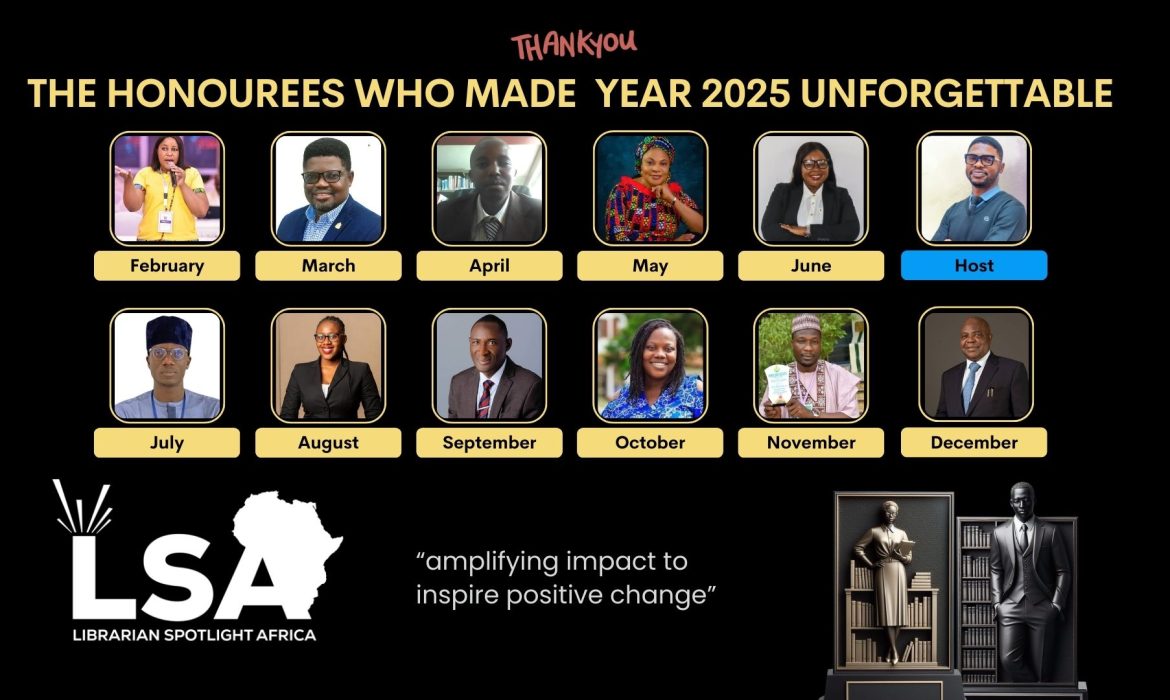
LSA has celebrated 11 honorees whose stories, achievements, and insights have reshaped the narrative of librarianship in Africa. Let us now reflect on the journey so far:
FEBRUARY 2025: Melba Sitwala – Namibia, (Strengthening Library Leadership)
Celebrated for her inspiring leadership and commitment to institutional growth and mentorship within the LIS community, Melba’s edition highlighted the importance of a strong foundation for library systems and professional development, encouraging librarians to continually strengthen their practices in service of teaching and research. She emphasized the importance of a positive attitude, inclusive behaviour, professional branding, clear communication, and strong digital competencies as essential skills for modern librarians. Click to watch the complete video
MARCH 2025: Dr. Ayodele J. Alonge – Nigeria, (Advancing Digital Transformation and Scholarly Communication)
Dr. Alonge’s journey, from community library beginnings to global influence in digital transformation and records management, emphasised how librarianship intersects with innovation, tech adoption, and lifelong service. His session challenged traditional perceptions, urging librarians to embrace modern skills and digital storytelling to make African library innovations globally visible. Dr. Alonge’s emphasized research integrity, open knowledge dissemination, and the need for librarians to support evolving scholarly and Digital ecosystems. Click to watch the complete video
APRIL 2025: David K. Koech – Kenya, (Promoting Information Access and Community Services)
David highlighted the community-centred dimensions of librarianship — that libraries are not merely book repositories but vital spaces for connection, learning, and digital inclusion. His insights underscored the need for passion-driven service, community engagement, and collaborative networks that strengthen access to information across diverse populations. His work in library services and community-focused information delivery demonstrated how libraries support learning beyond institutional walls. Click to watch the complete video
MAY 2025: Mrs. Martina O. Egwuibe – Nigeria, (Empowering Users through Information Literacy)
Martina a public librarian, champions readership campaigns, digital literacy programs, and impactful community engagement initiatives. In her edition, she demonstrated how user education and information literacy initiatives help bridge gaps between learners and resources in communities. Her career reflects a deep commitment to literacy advancement, institutional growth, and community empowerment through libraries. Click to watch the complete video
JUNE 2025: Dr. Nancy Kwangwa – Zimbabwe (Driving Digital Transformation and Inclusion)
Dr Kwangwa began her career at the Women’s Research Centre and Network, where she supported students and policymakers on issues related to gender and development. Her leadership in AI, digital equity initiatives and technology-driven library services showcased the role of libraries in inclusive knowledge access. Her edition inspired viewers to think beyond traditional functions and toward sustainable technological inclusion in LIS practice. Click to watch the complete video
JULY 2025: Damilare Oyedele – Nigeria, (Advocating Library Development and Access to Information)
Damilare’s work with Library and You and Library Aid Africa brought a fresh perspective on citizen engagement and digital innovation in library development. His focus on community partnerships and information mobilization guided conversations about how libraries can remain vital in the lives of everyday learners and community members. His session emphasized functional libraries as foundations for access to information, capacity building, and collaborative growth across African library systems. Click to watch the complete video
AUGUST 2025: Maggie Kambai – Zambia, (Expanding Health Information Access and Evidence Use)
Maggie’s story of evolving from medical librarianship and evidence-based information services to serving as executive assistant reminded viewers of the critical role that LIS professionals play in supporting healthcare knowledge, research evaluation, and strategic decision-making — even beyond traditional library spaces. Maggie’s philosophy calls on librarians to evolve into innovators, educators, and advocates, ensuring libraries remain vital centers for transformation. Click to watch the complete video
SEPTEMBER 2025: Prof. Adeyinka Tella – Nigeria, (Advancing LIS Research and Academic Excellence)
An academic and prolific researcher, Prof. Tella’s session emphasised the value of scholarship, mentorship, and academic excellence within the LIS profession. His contributions encouraged librarians to prioritise research, evidence leadership, and scholarly impact in their work. Prof. Tella is rated a C2 researcher by South African National Research Foundation. Click to watch the complete video
OCTOBER 2025: Dr. Monica M. Danquah – Ghana, (Championing Open Science and Capacity Development)
Dr. Danquah a distinguished scholar and advocate for scholarly communication and digital literacy in Africa serves as Senior Lecturer at the University of Ghana, Editor-in-Chief of the Ghana Library Journal, Chair of IFLA Sub-Saharan Africa, and Vice Chair of AfLIA’s Library Education & Training Section. Her edition explored digital libraries, research data management, and advocacy around open science and capacity building. Her leadership reflected the evolving role of librarians in facilitating digital knowledge ecosystems and fostering research-informed practice. Click to watch the complete video
NOVEMBER 2025: Nazir Muhammad – Nigeria, (Strengthening Library Innovation and Professional Collaboration)
Nazir’s work in academic library leadership and professional collaboration highlighted how strategic partnerships, innovation, and community engagement can strengthen institutional libraries and empower professional communities to work collectively toward shared goals. He is a dedicated library leader and advocate driving access to knowledge in northern Nigeria through digital tools, partnerships, and community outreach. Click to watch the complete video
DECEMBER 2025: Akogun Lanre Adesuyi – Nigeria, (Expanding Knowledge Infrastructure and Library Support)
The season concluded with a celebration of a visionary entrepreneur, publisher, and librarian whose contributions extend beyond librarianship into broader knowledge infrastructure and education. Akogun Lanre Adesuyi’s edition enlightened viewers about his work in publishing, library solutions, and expanding book access, which demonstrated the power of cross-sector support for libraries and reading cultures nationwide. Click to watch the complete video
Our Reflections and Prospects
Several patterns became clearer during this Season 2025. Professional recognition itself has value. The programme revealed how documenting individual contributions fosters reflection within the profession and provides reference points for emerging practitioners.
The research study our team presented at the 2025 NLA Conference, which explored the programme’s influence on professional advocacy and public perception of librarianship, further affirmed the value of intentional storytelling as part of broader LIS advocacy efforts. These insights will help shape Season 2026 and beyond.
Also, sustaining a volunteer-driven continental initiative presents structural challenges. Production demands, resource limitations, and audience reach remain ongoing considerations. Yet the continuity of the programme also revealed a strong underlying commitment among contributors and viewers. Engagement metrics from YouTube, Facebook, and LinkedIn show promising interest, but the true impact is best measured in the testimonials, professional inspiration, and networks formed through these conversations. Many viewers have noted how sessions encouraged new approaches to library work, research support, and community outreach.
Join Us in Shaping the Future of Librarianship!
As LSA moves forward, plans include expanding representation and partnerships with regional and international LIS organisations, and strengthening impact assessment strategies. Season 2026 will adopt a quarterly format to allow for deeper engagement, enhanced storytelling, and stronger audience reach.
Your feedback is very important in helping us grow and achieve our mission of redefining librarianship across Africa. Please take a moment to complete our Feedback / Impact Survey.
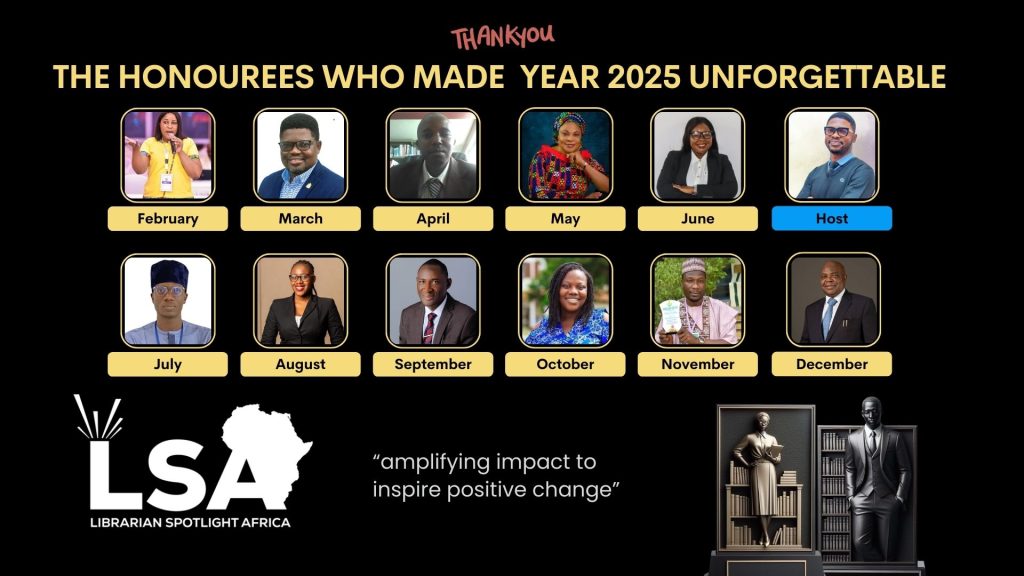
We extend our heartfelt thanks to all our honorees, viewers, and team members for making Season Two (2025) a success. Your support helped us bring this vision to life. As we prepare for Season Three (2026), which commences in March, do you know an outstanding librarian or changemaker who embodies innovation, leadership, and dedication to advancing libraries in Africa? Nominate them here for the upcoming season! Share our videos, and support our initiatives. If you’d like to volunteer and contribute your skills to this growing initiative, we’d love to have you on board. Volunteer here!
Librarian Spotlight Africa remains committed to shaping a future where the impact of African librarians are recognised, amplified, and empowered to further lead transformations in knowledge access and societal development.
Explore More: Access the full playlist of Seasons 2024 and 2025 episodes
(By Sylvester Ebhonu, Ramatu Haliru, Folasade Adepoju, Victoria Chukwuedozie and Mulugeta Woldetsadik)
SEEING IS NO LONGER BELIEVING!
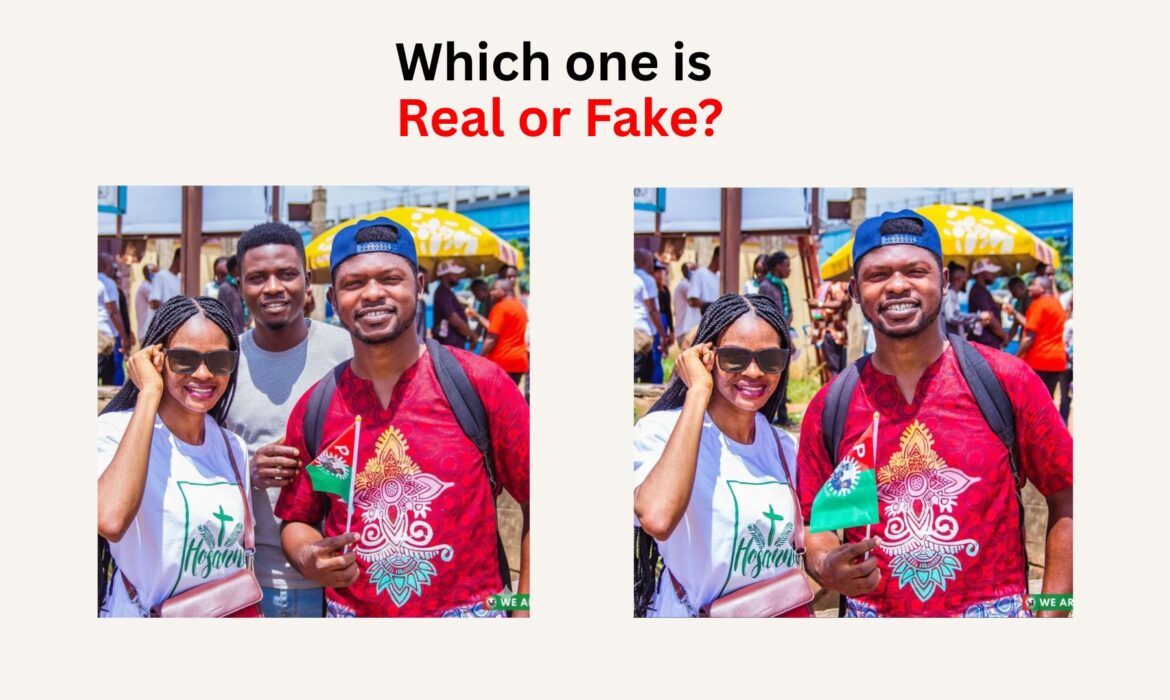
Today, January 28th, being World Data Privacy Day, I decided to run a small AI experiment after working hours. Take a look at the two images attached to this post: One of them is an original photo and the other is an AI-generated version where you’ll see that a third person was added seamlessly into the group.
It took me less than 2 minutes to change the state of the photo.
Today, the internet is now flooded with AI Slop and deepfakes.
It’s a great idea and usually fun for many content creators, but this ability raises a serious question for all of us, especially in this year, 2026: ‘Who owns our digital identity and how do we control what we put out there?’
In another experiment, I tried to push the AI further by asking it to create a specific physical interaction (like a peck on the cheek). The AI refused. So, I assumed that there was some sort of layer of Data privacy or safety guardrails that may have been built into the model, which prevents it from creating non-consensual or synthetic intimate moments that never happened.
How I see it though, is that, we still need to be vigilant, because… anyone could outsmart these AI systems through prompt injection techniques that makes the model thinks its doing something ethical.
I couldnt think of a better day than today, dedicated to mark #DataPrivacyDay, for us to remember that Consent is very important.
Just because generative AI platforms like Gemini’s Nano Banana, Grok, and other platforms allows us to add or remove people or manipulate images and videos doesn’t mean we have the right to do so without permission. It all boils down to the Responsible Usage of AI. We must acknowledge that these tools can easily be used to create false narratives or proof of events that may have never happened.
Considering the theme for the celebration, ‘Take control of your Data’, let us endeavour to be very, very mindful of the data we share, the tools we use, consciously protect our digital identities, and endeavour to consult with Librarians to learn about Responsible AI/Digital Literacy.
– Sylvester Ebhonu (TheDL)
NO BOOKS WERE SHELVED, BUT LIBRARIANSHIP HAPPENED HERE
Today (5th January 2026) was supposed to be a ‘lazy’ first day back at work, because I was still trying to adjust myself and put my to-do list for the week together when my first library users of the year 2026 walked in. I honestly thought they had come to exchange pleasantries. Happy New Year. Small Talk, and then they’ll go.
But they actually needed help.
I offered them a seat and they explained that they needed clarification on a group project they had been given in a course, with just two weeks to submission. Specifically, they needed reviews on their idea, some guidance on creating graphics, and suggestions on the right resources to use.
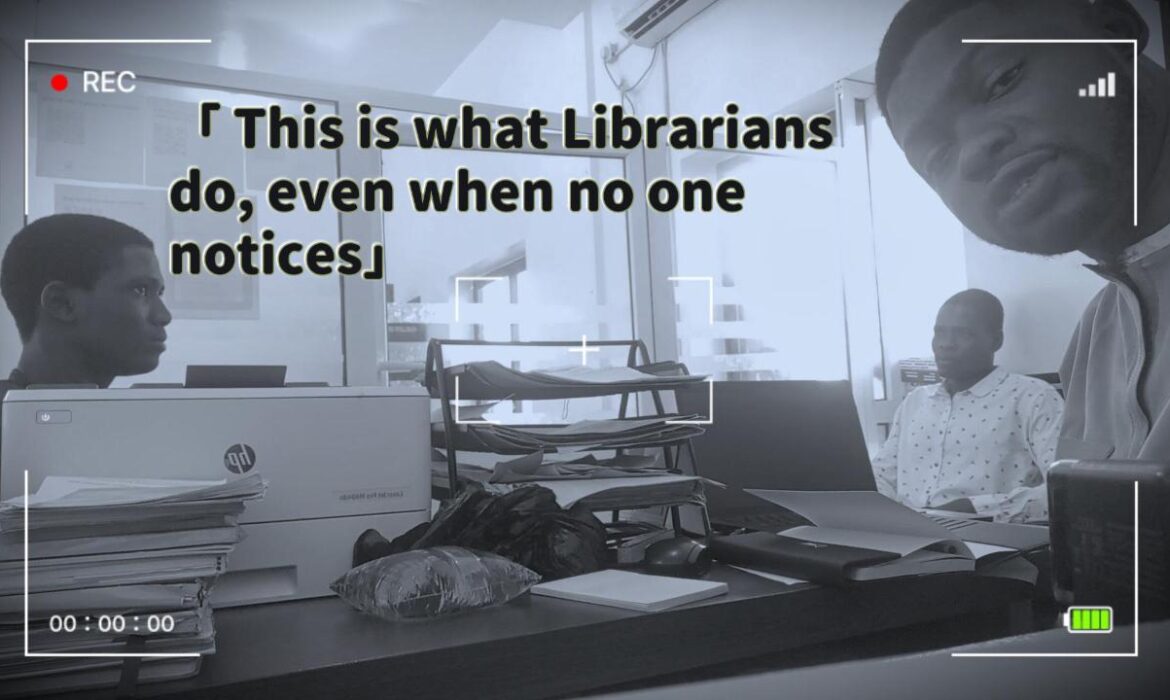
I asked for their permission to record the session without the audio, just the process and they agreed.
What followed was not what they expected.
Just as we are taught in library school, users often do not express their real information need at first. It is through careful questioning and professional listening, what we call the reference interview — that the real need becomes clearer. They had actually come with an idea they felt confident about. Innovative, yes. But as they explained it, it became obvious that it did not fully align with the goal of the assignment. That only became clear because I did not interrupt them by rushing to solve the problem and this changed the direction of the session.
Now, this short, silent video captures what a real reference and consultation moment looks like. Nothing was rehearsed, it was just librarianship in practice.
That listening changed the direction of the entire session. Now, this short, silent video captures what a real reference and consultation moment looks like. Nothing was rehearsed, just librarianship in practice.
There are lessons here that I hope librarians, LIS students, and even those outside the profession may find helpful:
- Librarians listen before they advise: The solution didn’t come from talking first. It came from making the student comfortable and understanding their problem (assignment) properly. Listening to them helped in making the gap visible.
- Understanding the assignment matters as much as understanding the topic: Many projects fail not because students lack ideas, but because the ideas do not answer the question that was asked. Helping users see that distinction is part of our work as Librarians.
- Librarians think on paper, not only in their heads: A pen, a jotter, or an internet enabled device/computer is a librarian’s companion. Note taking is a serious deal for us. I summarized key points as we spoke. At the end of the session, they relied on my notes and asked to take a photo to guide their next steps.
- With Librarians, teaching naturally happens: There was no official lecture or presentation of slides, yet learning happened. This is one thing I love about librarianship. We always… By the end of the session, they understood why their original idea needed adjustment and how to move forward with clarity.
- Librarianship is relational: Nowadays you find most students relying on ChatGPT for brainstorming on related issues like this. They could easily have searched online for clarity. But what happened here was not just information delivery. It was context, judgment, reassurance, and direction provided by a human librarian. This experience challenges the idea that technology can replace the librarian’s role.
- Ethics and consent are part of professional practice: The recording only happened after permission was given. No private details was shared and respect for users is not optional, even when documenting impact.
- Evidence of impact is very important: In some environments where people say librarians do nothing, evidence helps you speak. For many years, I have used reference interview forms to document user needs and outcomes. This year, I hope to experiment other responsible ways of capturing impact.
So, this was how my first day back at work looked like:
- No books were shelved.
- No one was shushed.
- No cataloguing
- But Librarianship happened 🤓!
Sylvester Ebhonu (TheDL)
Amiralty University of Nigeria, Ibusa

